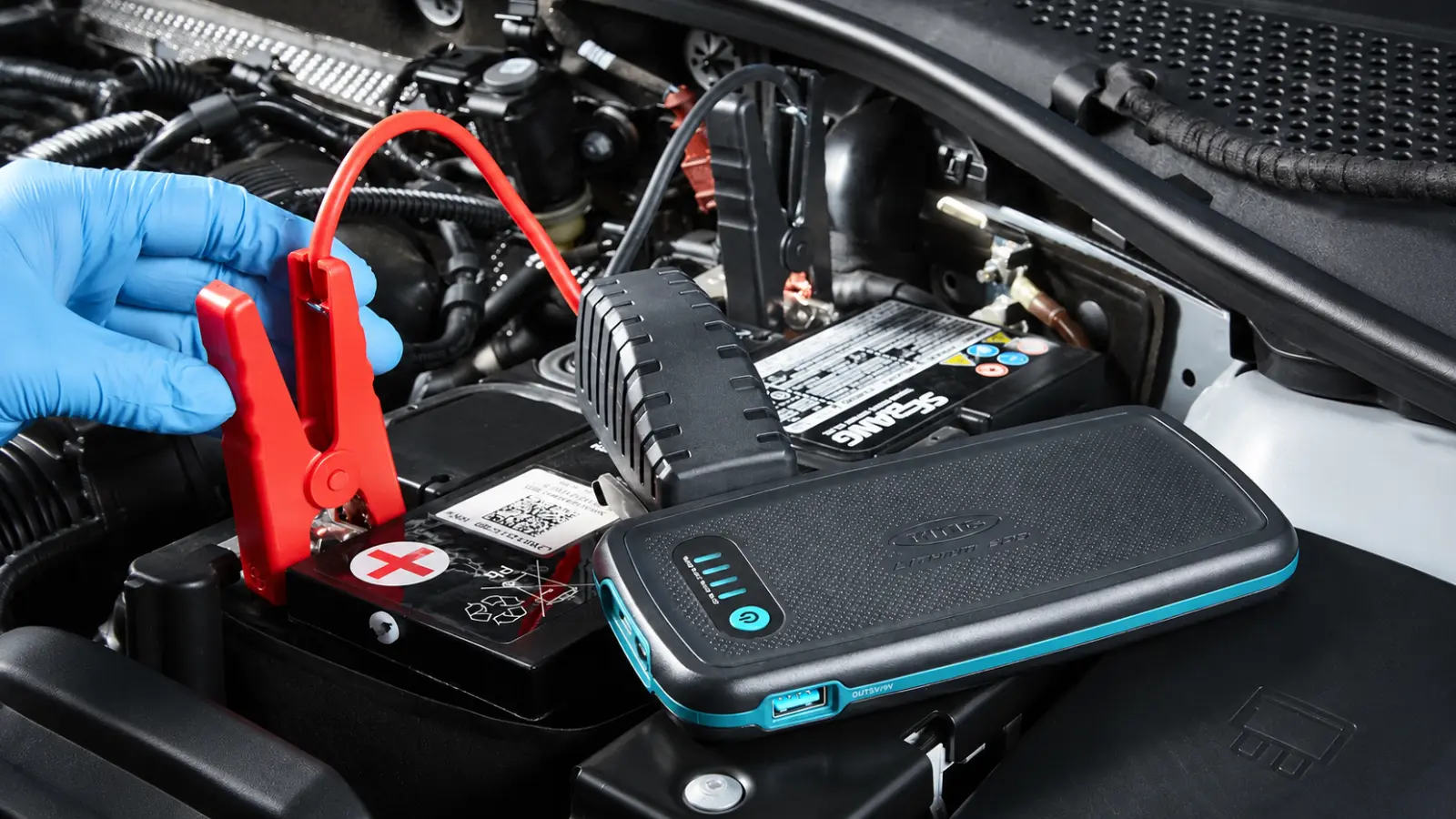

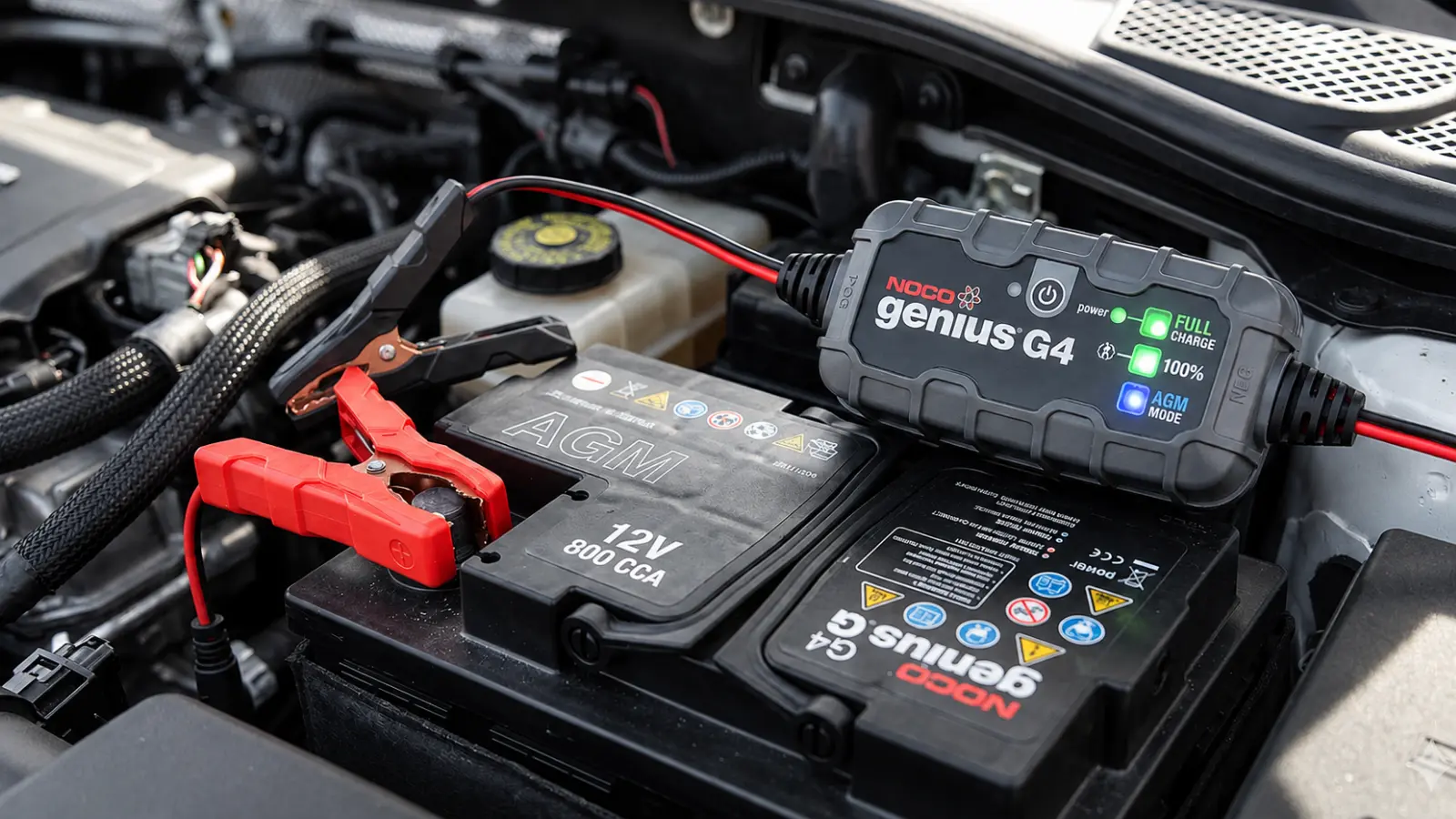
Learning how to charge a car battery safely starts with using the right charger for your battery type. For a conventional 12-volt starting battery, the basic process is to inspect the battery, connect the charger with the power off, select the appropriate charging mode, and allow the charger to complete its cycle before disconnecting it. A proper recharge can restore a low battery’s charge, but it won’t repair a worn-out battery.
Before connecting anything, check the battery for cracks, swelling, leaks, excessive heat, or signs of freezing. Never attempt to charge a damaged battery. You also need to confirm whether your vehicle allows charging with the battery installed and whether it requires designated charging terminals. The vehicle owner’s manual and charger instructions take priority over general procedures.
This guide explains how to charge a car battery step by step, choose between different charger types, connect and remove the clamps safely, and estimate how long charging may take. You’ll also learn what to do if the charger won’t start, how to check the battery afterward, and when professional help is the safer option.
What You Need Before You Start
Most owners can do this with a few basic items, and the job is usually easy on a car with an accessible battery. It gets harder when the battery sits under a seat or in the trunk, or when the manual calls for disconnection or registration afterward.
- A compatible charger: rated for 12-volt batteries and documented as suitable for your battery type (conventional, AGM, or EFB).
- The charger manual and the owner’s manual: they decide connection points and any in-vehicle limits.
- Eye protection and gloves: battery acid and corrosion are hazards, so wear eye protection whenever you work near the battery.
- A wire brush and baking-soda-and-water solution: only if the terminals are corroded. A multimeter is optional for checking voltage afterward.
Plan on several hours at minimum and often overnight. The time section below explains why.
Check That the Battery Is Safe to Charge
Look before you connect anything. Stop if the case is bulged, split, leaking, hot, or frozen, since charging a damaged or frozen battery risks gas, heat, and ignition. Don’t try to open a sealed battery or add liquid to it.
Also stop if the terminals, cables, or hold-down are badly damaged, or if you can’t identify the battery type from its label. Light surface corrosion is not the same as a damaged connection, but a heavily corroded or loose terminal should be dealt with before you charge. A maintenance-free battery is not risk-free: it only means you don’t add water.
Before you start, remove rings, watches, and loose metal jewelry, and keep metal tools off the battery. If the car is stopped somewhere unsafe, roadside assistance is the better answer than charging beside traffic.
Pick the Right Charger and Mode
Clamps that fit don’t make a charger suitable. What matters is the type of charger and whether its mode matches your battery.
| Tool | What It Does | Watch Out For |
|---|---|---|
| Automatic (smart) charger | Adjusts its output and signals when the battery is full | Choose the mode for your battery type. Some units need you to select it, and the default may not fit. |
| Manual charger | Delivers current continuously and doesn’t shut off on its own, according to AAA | Needs close monitoring and a stop at the right time. Don’t leave it unattended. |
| Maintainer or float charger | Holds a charged battery at full during storage | Not for recovering a flat battery, and VARTA advises limiting long float charging. |
| Jump starter or jumper cables | Provides a one-time starting boost | Not a charger. See our jump-start guide if you need to get moving first. |
A “12-volt” setting alone doesn’t mean every program is right. Look for the technology on the battery label (flooded, AGM, EFB) and use only a mode the charger maker says supports it. VARTA points out that a gel mode on some chargers isn’t compatible with AGM batteries. AGM and EFB are common with start-stop systems, but confirm the type from the label or documentation, not from the car’s features; our guide to AGM, EFB, and conventional batteries helps you read those labels.
Don’t pick a “repair” or “recondition” program just because the battery is low. Those modes aren’t universal, and whether they suit your battery depends on the charger and its instructions. When unsure, use the standard or lowest-rate program rather than a quick-charge or boost setting.
Charge It in the Car or Take It Out?
On many cars you can charge the battery where it sits, and that is usually the simplest route. Removal is worth considering only when the manual requires it or you can’t safely reach the terminals. Some vehicles, especially those with the battery in the trunk or under a seat, provide designated charging or remote terminals, so check the manual before attaching anything.
Don’t disconnect a cable or pull the battery just because an online guide did. Many chargers work with the battery connected, and removal can disturb vehicle settings, is heavy work, and on some vehicles calls for registration afterward. If the manual requires disconnection or removal and you can’t confirm the procedure, use professional service. In a hybrid or EV, treat the 12-volt battery as a separate low-voltage system, use the manual’s designated points, and leave orange high-voltage cabling alone.
How to Charge a Car Battery, Step by Step
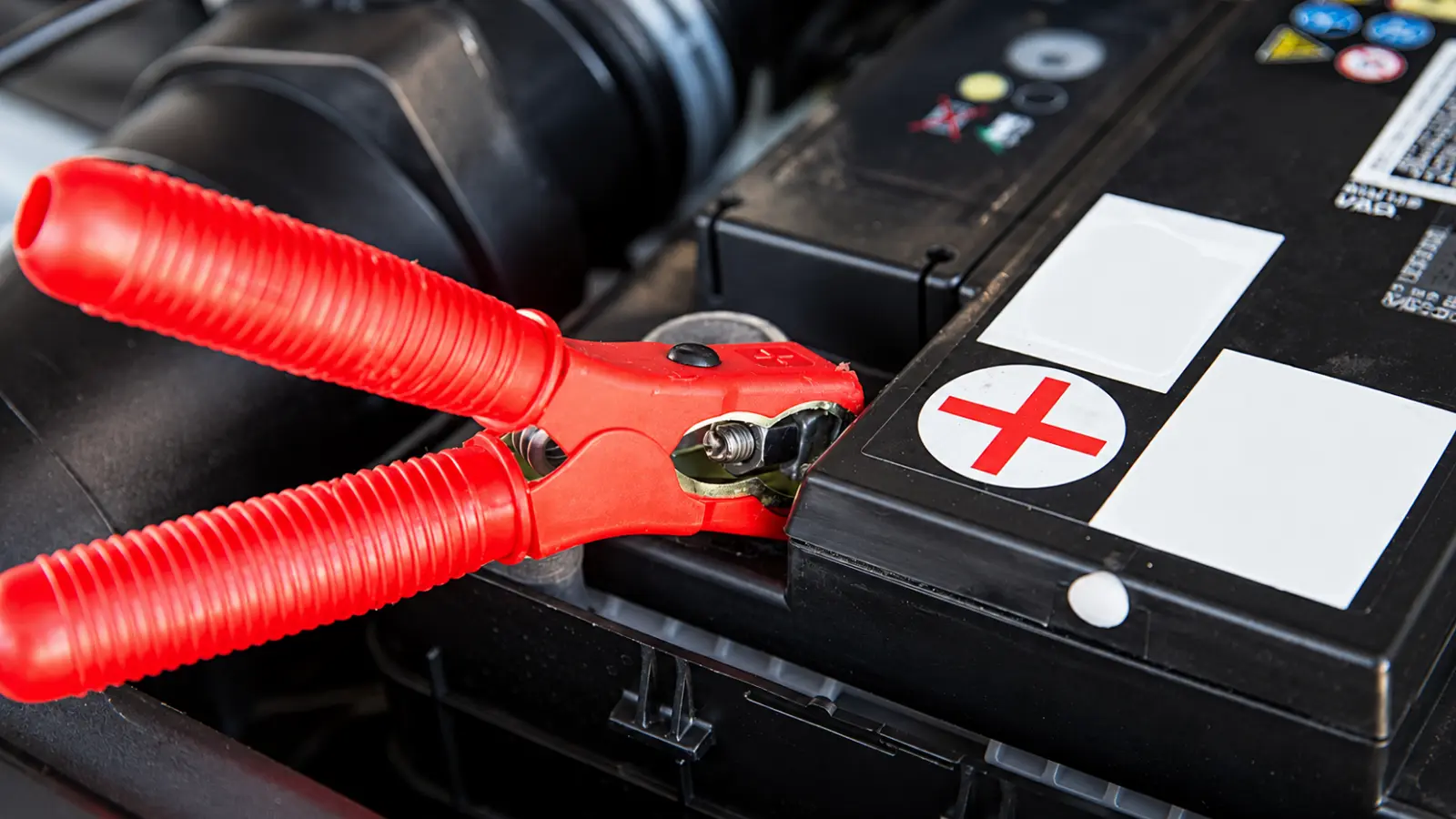
The exact buttons differ by charger, but the sequence below is the general order. Safety steps come first because the sparks that matter happen at connection and disconnection.
- Prepare the car and the area. Park on a flat surface, turn the ignition off, and switch off all lights and accessories, as VARTA advises when the battery stays in the car. Set the charger on a stable surface as far from the battery as its leads allow, not balanced on the fender or engine, and keep cords away from belts, fans, hot parts, and walkways.
- Make sure the charger is off and unplugged. Check the leads and clamps for breaks or fraying.
- Connect the red (positive) clamp to the positive terminal. Make firm contact, and don’t let the clamps touch each other or other metal.
- Connect the black (negative) clamp. Follow your charger and vehicle instructions. Where they’re silent, many guides direct it to clean, bare metal on the engine or chassis away from the battery, fuel lines, and moving parts, which keeps any spark away from battery gas. Some instructions use the negative terminal instead, particularly with the battery out of the car, and some vehicles specify a designated ground point.
- Select the mode. Set 12 volts, the correct battery type, and the standard or lowest-rate program.
- Plug the charger in and switch it on. VARTA notes that the charger should be connected to the battery before the mains.
- Monitor the charge. Follow the charger’s indicators. Stop and switch it off if the battery gets hot, smells like rotten eggs, leaks, swells, or smokes, or if the charger shows a fault. Don’t touch a hot or leaking battery.
- Finish in the right order. When an automatic charger reports full, or when you stop a manual one, switch off and unplug the charger first. Then remove the black clamp, then the red, without letting them touch.
- Reconnect or refit anything you removed. If you disconnected cables, put the positive back first and the negative last, as the manual directs.
How long does it take? There is no single safe number, but you can plan. VARTA’s rule of thumb is to divide the battery’s amp-hour rating by the charger’s amp rating, which works out to about 15 hours for a 75 Ah battery on a 5-amp charger, and it says 12 to 24 hours is typically enough. Battery condition, temperature, and charger output all change that, and an automatic charger’s completion indicator is a better guide than a timer.
If the Charger Won’t Start or the Battery Won’t Charge
A battery that has been flat for a long time sometimes isn’t recognized, and that is a signal to stop and diagnose rather than force it.
- Charger shows a fault or won’t begin: recheck polarity, clamp contact, and the selected mode. OPTIMA notes that some chargers won’t act on a battery below their minimum operating voltage, and measuring voltage before and after charging shows whether the charger delivered anything.
- Battery gets hot or swells: stop immediately. This is a damaged-battery situation, not a setting to tweak.
- Charges, then goes flat again soon: the battery may no longer hold a charge, or something is draining it. That’s a test and diagnosis question.
Don’t improvise workarounds to wake a charger, such as connecting a second battery. If you can’t get a clean, documented charge, a shop can test the battery and decide whether it is recoverable.
After Charging: Rest, Retest, and Find the Cause
A charged battery may start the car, but that doesn’t prove it can hold the charge or that the charging system is working. Let the battery rest after charging, because a reading taken right after can look better than the battery really is. On a conventional lead-acid battery, about 12.6 volts at rest is commonly associated with a full charge. That figure describes charge, not health, so use a proper battery test or have one done. Our car battery testing guide explains the methods.
Then ask why it needed charging. Short trips, an accessory left on, storage, poor connections, battery age, a parked electrical draw, or a charging-system fault may all be involved. If it keeps happening, use our guide to why a car battery keeps dying to sort the evidence instead of charging it again and hoping. For a car that will sit, charge it first, then use a maintainer only if the vehicle and maintainer documentation both support it; a maintainer is for keeping a good battery charged, not for fixing a battery that repeatedly goes flat.
When to Stop and Call a Professional
Use a shop or roadside service if the battery is damaged, if you can’t confirm the right charger mode or connection point, if the manual requires disconnection or removal you can’t verify, or if the vehicle needs registration or coding after power is removed. The same goes for a hybrid or EV where you can’t identify the low-voltage connection points. Your own safety and the car’s electronics both outrank saving a service call.
How to Know Your Car Battery Is Ready After Charging
Charging a car battery safely depends on using a compatible charger, selecting the correct mode, and following the connection and disconnection procedures in the vehicle and charger manuals. For an automatic charger, the completion indicator is a better guide than a fixed number of hours. Once charging is finished, switch off and unplug the charger before removing the clamps as instructed.
A completed charge doesn’t necessarily mean the battery is healthy or that the original problem has been solved. Let the battery rest before checking its voltage, and have its starting performance tested if the vehicle has been struggling to start. If the battery repeatedly loses charge, investigate its condition, the connections, and the charging system instead of relying on repeated charging sessions.
Frequently Asked Questions
How do you charge a car battery with a battery charger?
Turn off the vehicle and unplug the charger. Following both manuals, connect the red clamp to the positive (+) terminal and the black clamp to the approved negative or ground point. Select the correct battery type and charging mode, then switch on the charger. When charging is complete, turn it off and unplug it before removing the black clamp, then the red.
How long does it take to charge a car battery?
Charging time depends on battery capacity, remaining charge, temperature, and charger output. A 75 Ah battery on a 5-amp charger has a rough baseline of 15 hours, although actual charging may take longer. Many batteries require 12–24 hours, so follow the charger’s completion indicator rather than relying on a timer.
Can you charge a car battery without removing it?
Yes. Many vehicles allow the 12-volt battery to be charged while installed, provided the charger is compatible and the manufacturer’s instructions are followed. Some vehicles require designated charging points or special procedures, so check the owner’s manual before connecting or disconnecting anything.
Can you leave a car battery charger on overnight?
Only when the charger is designed and approved for that use. An automatic smart charger may stop charging or switch to maintenance mode when the battery is full. Manual chargers require close monitoring and should not be left running unattended.
Can you charge an AGM car battery with a regular charger?
Only if the charger explicitly supports AGM batteries and provides an appropriate charging mode. A standard 12-volt setting alone does not guarantee compatibility. Using an unsuitable charging program can damage the battery.
Why won’t my car battery charge or hold a charge?
A charger may refuse to start because of poor connections, incorrect settings, or battery voltage below its operating threshold. If the battery charges but quickly goes flat again, possible causes include battery deterioration, excessive parked electrical drain, or charging-system problems. Have the battery tested before replacing it.